
What Is Art Coaching, and What Does a Creative Guide Actually Do?
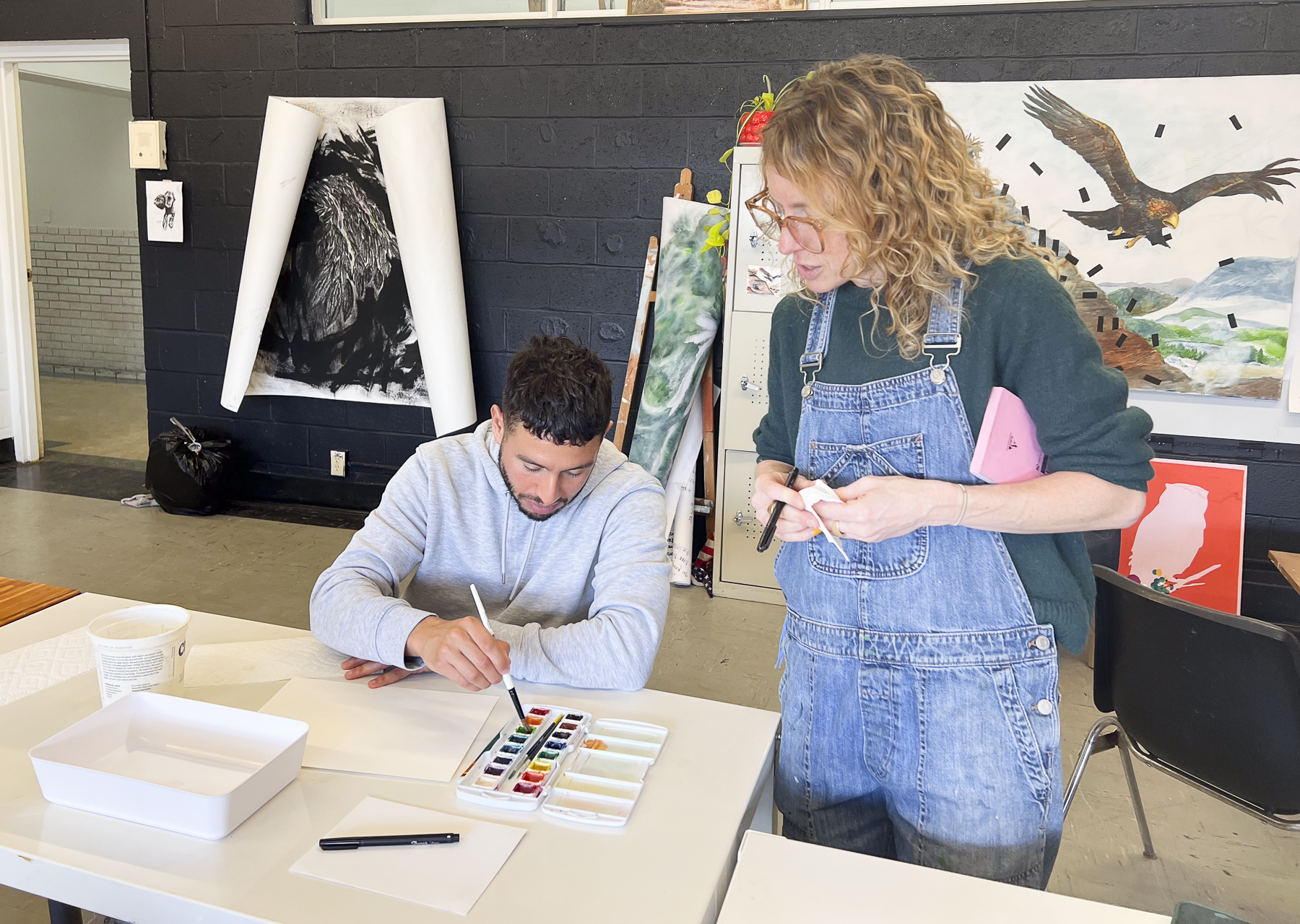
A lot of people who reach out to me aren’t entirely sure what’s stopping them. They know they want to make more art, or finally start, or find their way back to something they’ve lost. But they can’t quite name what’s in the way.
That’s usually where we begin.
It’s Not About Learning to Draw
Art coaching isn’t about technique. There are wonderful resources for that, classes, YouTube tutorials, books, workshops. What a creative guide offers is something different: a dedicated space to slow down, pay attention, and start trusting yourself again, with personalized structure and support along the way.
We all have an innate creative intelligence that is uniquely ours. It’s not something you can think your way through, and often words are not enough. When we access this deeper part of ourselves, something sacred can emerge. You already have it all within you. All I do is help you give it light. The materials become a kind of language, one that often gets to the truth faster than words do.
Our culture is really good at convincing us that we are here to strive, produce, and achieve financially, and while all of those things can be important at times, the fundamental truth is that we are here to create. We live in a world of abundance, and the closer we connect to that source, the richer and more meaningful our lives become. Nurturing a creative practice that allows you to develop and channel a sacred flow makes way for a truly magical existence.
What Gets in the Way
There are so many things that pull us away from our creative lives. Perfectionism. The inner critic. The sense that art is a luxury, something to get to after everything else is handled. The weight of a to-do list that never gets shorter.
And sometimes it’s something heavier. Grief shows up in so many ways and has a way of silencing the parts of us that want to make and express and play. Loss, whether of a person, a relationship, an identity, or a season of life, can make creativity feel impossibly far away. Or sometimes, surprisingly close. The relationship between grief and creativity is something I return to often in this work. Many people find that artmaking becomes one of the few places where grief can actually move.
Whatever is in the way, there’s often an energy behind it that just needs to be moved, and working somatically is the most effective way of making those shifts. It’s amazing how creating can offer a chance to separate from and see the things that block us, and how new perspectives can quietly unfold in the process.

What Sessions Are Like
Sessions always begin with grounding. We slow down and connect with the present moment, often through a short breath-based artmaking exercise. It’s a way of shifting out of thinking mode and into a different kind of knowing, the kind that lives in the body and the hands.
From there, we follow what surfaces. Sometimes that means looking at work you’ve been making on your own and talking through what you notice. Sometimes it means experimenting with intuitive painting or other materials in a new way. The session takes the shape it needs to take.
There is also something about having a dedicated time and someone genuinely waiting for you that makes the practice real in a way it rarely is when we try to do it alone. You bring the raw material. I’m there to help you see it more clearly.
What You’re Actually Building
Over time, something shifts. The perfectionism loosens. The inner critic gets quieter, or at least less convincing. You start to trust your instincts more, not just in the studio but in the rest of your life too.
That’s the thing about creative practice: it doesn’t stay contained. Learning to stay curious when something isn’t working, to experiment without needing to control the outcome, to keep going even when it feels uncomfortable, these are life skills.
Part of what makes this work is simply having someone in your corner who cares whether you showed up to the studio this week and what happened when you did. My goal as a creative guide is always to help you build something sustainable. A practice that is yours, that fits your life, and that you can return to on your own, not just when we’re meeting together.
Who This Is For
Art coaching tends to work well for people who already sense that there’s a more alive creative life waiting for them. Maybe you’ve been making art for years but it has started to feel hollow or formulaic. Maybe you haven’t made art since you were a child and you’re not sure how to find your way back. Maybe you’re moving through grief or a major life transition and you need somewhere to put what you’re carrying.
Maybe you know exactly what you want to create but keep letting life get in the way. Sometimes what we need isn’t more motivation but someone to help us hold the space for it.
Or maybe you just know the pull is there, and you’re finally ready to do something with it. You don’t need prior art experience. You don’t need to know what you want to make. You just need to be willing to show up.
If any of this resonates, I’d love to hear from you. I work with clients in Lancaster, across Central Pennsylvania and the Philadelphia area, and virtually.